🧵 Korean Folktale Series 84
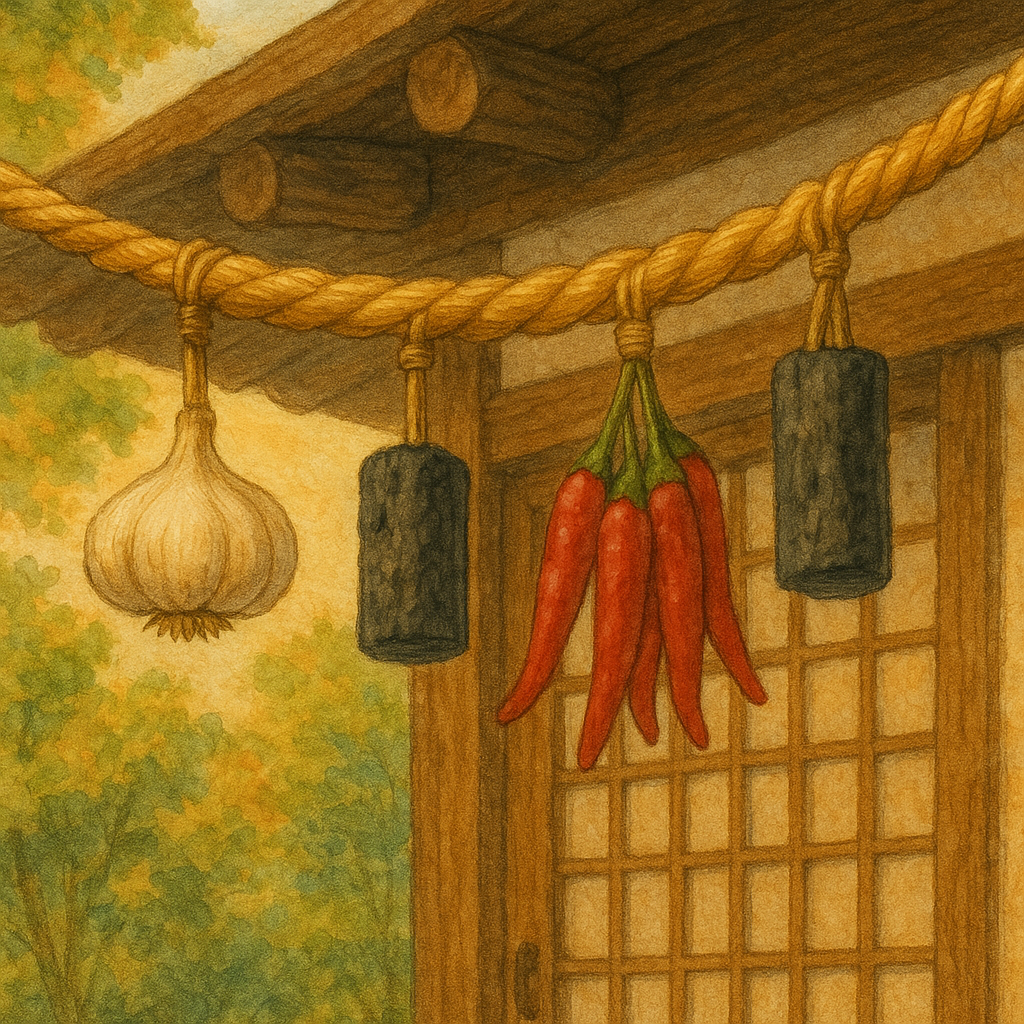
“The Story of the Sacred Straw Rope”
(지킴이 금줄 이야기·Jimigi Geumjul Iyagi)
🕰️ 1. The Story
Long ago, in a quiet village surrounded by mountains and streams, there lived a community that believed deeply in the unseen boundaries of the world. When a child was born, when illness threatened a home, or when something sacred needed protection, the villagers tied a straw rope called Geumjul across the doorway.
The Geumjul was simple—twisted rice straw, sometimes adorned with red peppers, charcoal, or pine branches. Yet everyone knew its meaning.
“Beyond this line,” they said, “only good intentions may pass.”
One spring night, a young couple welcomed their first child. Fearing misfortune, they tied a fresh Geumjul across their gate. The straw smelled of earth and sun, and it swayed gently in the breeze.
That same night, a wandering spirit drawn by human warmth approached the house. It meant no harm, but its presence alone could bring sickness or fear. As it neared the gate, it stopped.
The Geumjul glowed faintly, and a quiet voice echoed—not loud, not threatening, but firm:
“This home is under care. Turn back.”
The spirit bowed its head and retreated into the forest.
Days passed, and the child grew healthy. Neighbors respected the rope, never crossing it without permission. Even animals seemed to pause before the gate, as if understanding the boundary.
One day, a traveling merchant mocked the custom.
“How can straw stop danger?” he laughed, stepping forward.
The moment he crossed the rope, he stumbled, his goods spilling into the dirt. Embarrassed and shaken, he quickly stepped back and apologized. From that day on, he never doubted the quiet power of respect.
When the child reached one hundred days, the family untied the Geumjul and thanked the village. They did not discard the rope carelessly. Instead, they placed it beneath an old pine tree, returning it to the earth.
The elders taught the children,
“The Geumjul does not guard with force.
It protects by reminding us where care begins.”
And so, the sacred straw rope remained not just a custom, but a promise—
that boundaries, when made with love, become protection for all.
🪄 2. Meaning & Lessons
▪️ Boundaries are acts of care, not exclusion.
▪️ Respect for the unseen brings harmony to daily life.
▪️ Protection begins with shared understanding, not fear.
👀 3. Reflections in Life
▪️ Not all strength is loud—some is quiet and steady.
▪️ Traditions teach us how to care without controlling.
▪️ A simple symbol can hold deep communal wisdom.
🌏 4. Similar Tales Around the World
Japan — Shimenawa (Sacred Rope)
A straw rope marking holy spaces and keeping impurity away.
China — Door Charms of Protection
Objects placed at entrances to guard homes from harmful spirits.
India — Protective Threshold Rituals
Lines and symbols drawn to protect households and welcome blessings.
💬 A Warm Saying
“A boundary made with care becomes a shelter, not a wall.”
📌 Note
This is creative cultural content from the Misojieum Story Blog (kor-telling.com).
Please do not copy without permission. Sharing is welcome with proper source citation.
'Korean Folktales & World Folktales' 카테고리의 다른 글
| Korean Folktale : The Fidelity of a Goryeo Woman (1) | 2026.01.13 |
|---|---|
| Korean Folktale : The Flying Squirrel and the Woodcutter (1) | 2025.12.28 |
| Korean Folktale : The Tears of the Mirror Goddess (0) | 2025.12.21 |
| Korean Folktale : The Child Who Reunited with Heavenly Parents (0) | 2025.12.09 |
| Korean Folktale : The Legend of the Three Brothers’ Rock (0) | 2025.11.30 |
| Korean Folktale : The Lovers Who Kept Their Promise Across Lifetimes (0) | 2025.11.28 |
| Korean Folktale : King Mu of Baekje and Princess Seonhwa (0) | 2025.11.26 |
| Korean Folktale : The Ghost of the Field Path and the Grandmother (0) | 2025.11.26 |